Chapter 2
Intelligence
IQ refers to Intelligence Quotient
Stigl belives he has a low IQ and that Luna has a high IQ. Although nothing has proved that yet. Thats what this book aims to do.
The average Humanoid has an IQ between 85 and 115. Anything under 70 is considered low.
Luna and Stigl's approximate definition of IQ. (Not to scale)
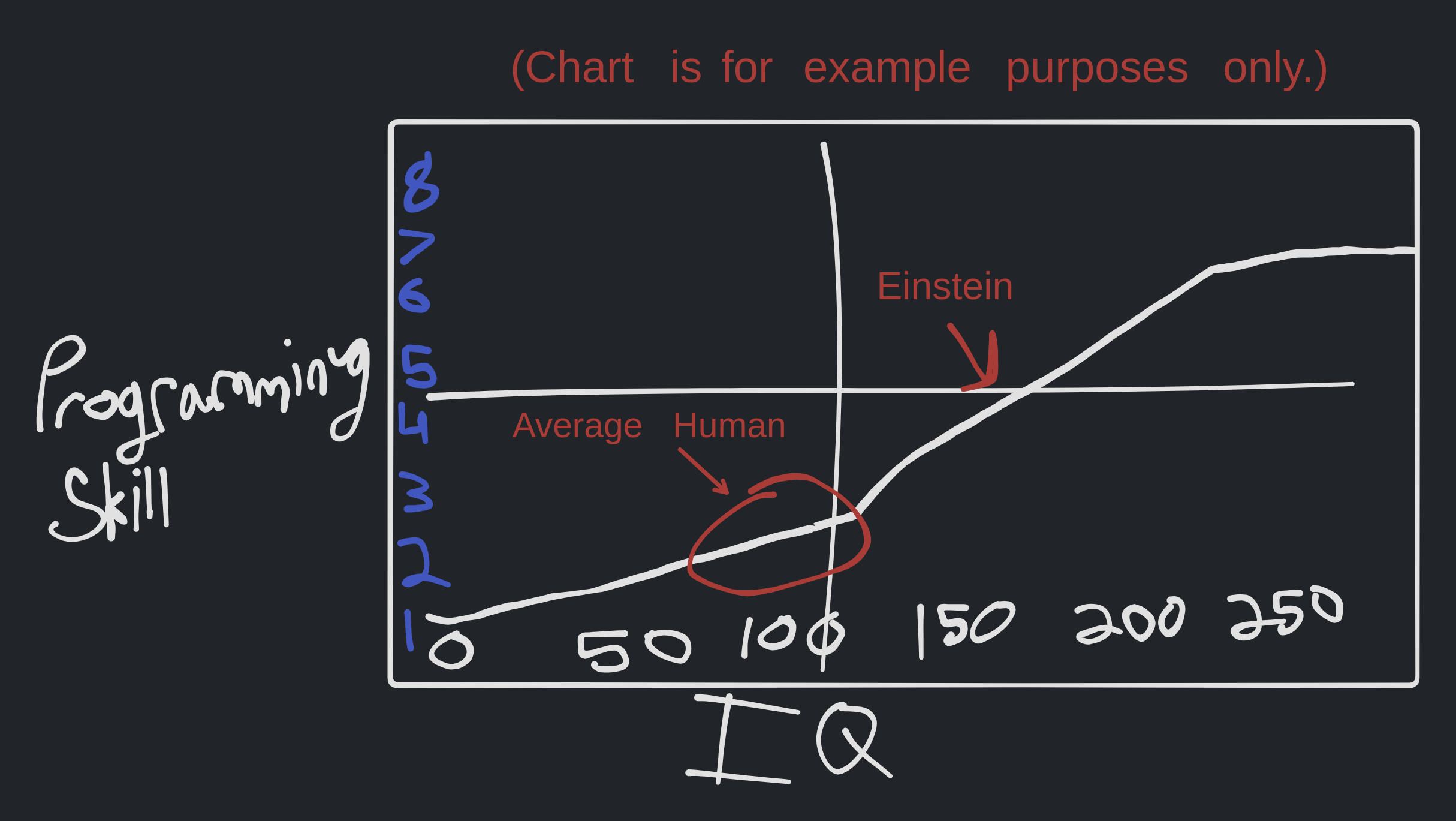
According to this chart, programming skill directly matches with IQ, lets take this into consideration and figure out the true IQ of Stigl and Luna.
An average human is around a 2.
Lets define 8 as being able to program anything you can think of without any difficulty, and 1 being knowing absolutely nothing.
This would mean 2 would be:
- Knowing how to program in multiple languages.
- Not being perfect
- Needing to use external resources (Google, Stack Overflow, ChatGPT)
- Able to implement a lot of things when given enough time
Stigl's IQ
Okay, that simplifies it a bit, lets see where Stigl is on this.
All data taken from publicly accessible resources.
On Github, Stigl has a project called SemiColonLang. In this project there is a programming language with a syntax consisting of only {};.
This language includes
- Basic parsing and lexing(?)
- Assembly codegen
Lets analyze this project to see what skills are being used.
The first 3 lines of Program.cs are
using System.Text;
class Program{
    //Command to run: dotnet run a; nasm -f elf program.asm;ld program.o -o o -m elf_i386;./o ```
As you can see, Stigl is using the Linux shell to run Dotnet and Nasm. This means Stigl can use the Linux shell for basic tasks.
Later in the code, (Line 56 as of commit 12ab000) we see
switch(val[0]){
Switch cases are used in programming to make code run faster as opposed to if statements as they use memory mapping instead of conditional boolean statements that require computing the value. They are fairly simple but it takes a good programmer to know where to use them.
After that is the assembly codegen, it does not use any optimization steps but it does include control flow and many other useful features that are in programming languages.
This program is well made and formatted and follows many best practices.
If I were to rate it on the scale shown above, I would put it somewhere in the 2.4-2.6 range.
Next we will look at a newer project called JASPL.
This language has a significantly more advanced syntax than Semicolon Language and is written in C++, a more advanced language than C#.
Lets take a look at the code. (Based on commit 64c165d)
bool isValidNumber(const std::string& str) {
    try {std::stod(str);return true;}
    catch (const std::exception& e) {return false;}
}
This code is very readable. It relies on C++ exceptions though, and exception handling can be messy at times. Lets look at a slightly improved version of this code.
bool isValidNumber(const std::string &str) {
    return std::all_of(std::begin(str), std::end(str), [](char i)
                       { return i == '-' || isdigit(i); });
}
This code does not use exceptions and is purely functional. Both versions perform similarly but in my personal opinion, the functional alternative is cleaner.
The functional implementation is not 100% compatible for the with the original. But for use in a parser, it works perfectly fine.
Once again this program is well written and readable. It turns JASPL into nasm assembly. I rate this code in the 2.5-2.8 range.
From these examples. I would put Stigl at a 2.6. That would mean Stigl's iq is ~110-115.